
FreddoIndex.com
Britain's favourite inflation indicator!
Average price calculated from 'the big 3' UK supermarkets daily!
Price History
What is the FreddoIndex?
The “Freddo Index” started as a meme, but with ever-soaring prices we decided to start tracking them properly!
Why Freddos?
Freddos hold a special place in British culture - a childhood treat that many remember fondly. Over time, they’ve also become an internet shorthand for rising prices: memes, social posts, and news stories often use “the price of a Freddo” as an instantly relatable way to talk about the cost of living.
That’s because Freddo prices have climbed noticeably faster than officially reported inflation rates over long periods. Full Fact found that from 1999 to 2017, Freddos rose about five times faster than inflation.
Data & methodology
Every day we pull Freddo prices from the big three UK supermarkets — Asda, Tesco and Sainsbury's — then track the average price over time. Prices update daily every morning using automated scraping. We calculate a simple average of these three prices to get our daily FreddoIndex value. This gives us a mainstream supermarket view of pricing, though prices can vary regionally and in smaller shops.
The chart shows both the actual average price (solid line) and what the price would be if it had only increased with official UK Consumer Price Index (CPI) inflation (dashed line).
Inflation calculations are based on official UK CPI data from the Office for National Statistics. The theoretical inflation-adjusted price is calculated by applying cumulative CPI inflation rates year-on-year from the 2000 baseline of 10p.
Important note: While we strive for accuracy, FreddoIndex should be treated as a fun approximation and not an official data source - we're sorry if we've made any mistakes!
The Freddo Price History
From 10p treats to tiny luxury — the Freddo story is a fascinating snapshot of how UK prices have crept up over time, far outpacing official inflation rates.
The golden age: 10p Freddos (1999-2006)
Back in 1999 and the early 2000s, Freddos were the classic 10p chocolate bar — a staple of childhood pocket money and corner shop visits. For years, this price remained stable, making Freddos an affordable treat that many Brits remember fondly. The FreddoIndex uses 10p in 2000 as its baseline, representing this era of stable, accessible pricing.
Remarkably, Freddos stayed at 10p until around 2006 — seven years without a price increase, despite general inflation in the economy. This stability made the subsequent price rises all the more noticeable and, for many, shocking.
The first jump: 17p (2007-2010)
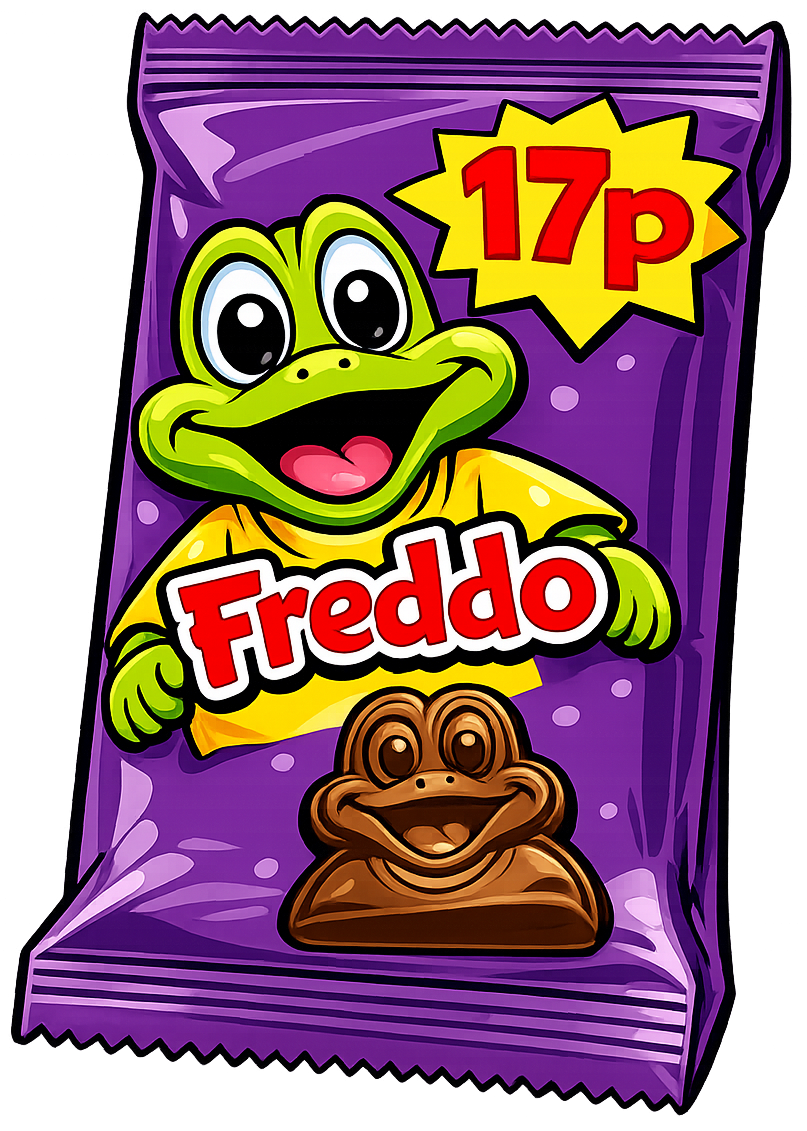
Around 2007, Freddos made their first significant price jump to 17p — a 70% increase that marked the end of the 10p era. This wasn't just a price change; it also coincided with a weight change. The British Freddo actually started at 17g in 2007, then grew to 20g later that same year, before eventually settling at 18g in 2011.
This period marked the beginning of what would become a pattern: price increases that far exceeded inflation, combined with subtle changes in product size. If Freddos had only increased with inflation, they would have cost around 11p in 2005 and 13p in 2010 — significantly less than the actual 17p price.
Accelerating costs: 25p era (2014-2018)
By 2014, Freddos had reached 25p — a 150% increase from the original 10p price. But the inflation-adjusted price should have been only around 15p, meaning Freddos were costing 67% more than they "should" have based on official inflation rates.
The situation worsened in 2017, when prices jumped to 30p in some parts of the country — even earlier than many had predicted. This represented a 200% increase since 1999, while inflation would have suggested a price of just 15p. According to Full Fact, this meant Freddos were rising about five times faster than the official rate of inflation.
This dramatic increase caught public attention, with news outlets reporting on "Freddogate" and social media users expressing outrage at the price of what was once a humble 10p treat. Even the March 2018 price drop — the first in the product's history — couldn't stop the relentless march of price rises: Freddos fell back to 25p briefly, but the overall trend has remained upward ever since.

Today and beyond

Today, Freddos typically cost between 25p and 30p (or more in some locations), while the inflation-adjusted price would be around 15-20p. The gap between the real price and the theoretical inflation-adjusted price shows how much "extra" inflation Freddos have experienced compared to the official basket of goods.
This gap represents the real-world experience of inflation for many consumers — prices rising faster than official measures suggest, making everyday treats feel increasingly like luxuries. The Freddo story is a microcosm of broader economic trends, making it both a nostalgic memory and a powerful economic indicator.
FreddoIndex Merch Empire
We'd love to sell you something inspirational here. Unfortunately, we have absolutely nothing to flog.
Coming Soon™
No mugs. No T-shirts. No "I Survived 30p Freddos" tote bags. Not yet anyway...
For now, the only thing on offer is the existential dread of watching a small chocolate amphibian relentlessly outpace the CPI.
If you make something fun with the FreddoIndex — a project, a meme, a dissertation on chocolate-based macroeconomics — let us know and we'll proudly display it here as if it was our idea.
Say Hello
Questions, ideas, or cherished Freddo memories to share?